Important Australian + International Fine Art - 9 May 2007 - 10 May 2007 | Melbourne
synthetic polymer paint on linen
198.0 x 167.5 cm
Lot Details
Description
Dale Hickey
synthetic polymer paint on linen
198.0 x 167.5 cm
signed and dated lower right: Dale Hickey 04
John Buckley Fine Art, Melbourne
Private collection, Melbourne
Dale Hickey: New Paintings, John Buckley Fine Art, Melbourne,20 July - 13 August 2005, as 'Untitled (Studio Series)'
This work has been requested for inclusion in the major Dale Hickey survey exhibition planned by the Ian Potter Museum of Art, University of Melbourne, February 2008.
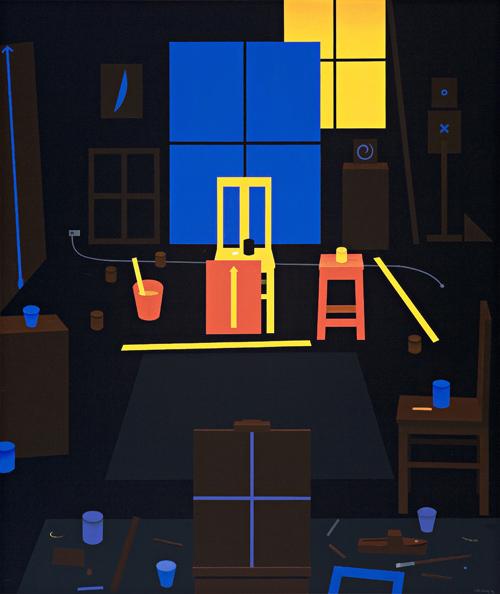
Dale Hickey's Easel Painting 2004 brings to mind Jan Vermeer's The Artist's Studio c1665/66 in the Künsthistorisches Museum, Vienna. Both are about painting and the studio. In Vermeer's masterpiece, the artist sits in the studio before his model. In Hickey's, the studio is the model. A classic composure pervades both, and both explore the art and nature of painting. Hickey's painting is like a still life. It certainly is still. The hard-edged objects of the studio can be read in terms of realism and abstraction, the three-dimensional illusion of space, or flat, geometric shapes in tightly balanced arrangement. Hickey is wedded to the flatness of the picture plane, the paint on the canvas celebrating the beauty of its surface qualities. He orchestrates with the painter's tools of perspective and investigates ideas and styles, from minimalism, to conceptual art to postmodernism. The engaging compositional device of the high viewpoint also acts as a metaphor- this is holy ground not to be entered, a place of creation. Colours are essentially confined to primaries, exploring and celebrating the resonances of the blues and yellows. Like Vermeer, there are paintings within the painting as Hickey moves the from the actual, in which we see the depiction of the back of the canvas on the easel, several times repeated, and then reappearing as the window, of rectangles within rectangles. Creativity is a private affair between the artist and his canvas.
DAVID THOMAS